EdgeQuake
Graph-RAG in Rust: one binary, one Postgres, any LLM. It reads PDFs and text, builds a knowledge graph in PostgreSQL, and answers questions with sources. Six retrieval modes: naive, local, global, hybrid, mix, and bypass. Apache 2.0.
EdgeSQL reads a Postgres or Databricks statement, resolves every column, and edits a copy of the syntax tree. You preview the change, then apply it. When the change cannot be safe, it stops and names the reason.



A string edit cannot tell a column name from a comment. It cannot tell which table owns a column. It breaks when two edits touch the same name. EdgeSQL keeps the parsed tree instead. A rename knows the table, the CTE hops, and the output name it must keep.
Scope and column rules live in one module. Filters, columns, and renames all read the same answer.
Preview returns the before SQL, the after SQL, an AST diff, a semantic diff, and a fingerprint. Apply refuses a blocked preview.
Every error has a phase, a code, and a hint. The library emits no SQL when it cannot explain the statement.
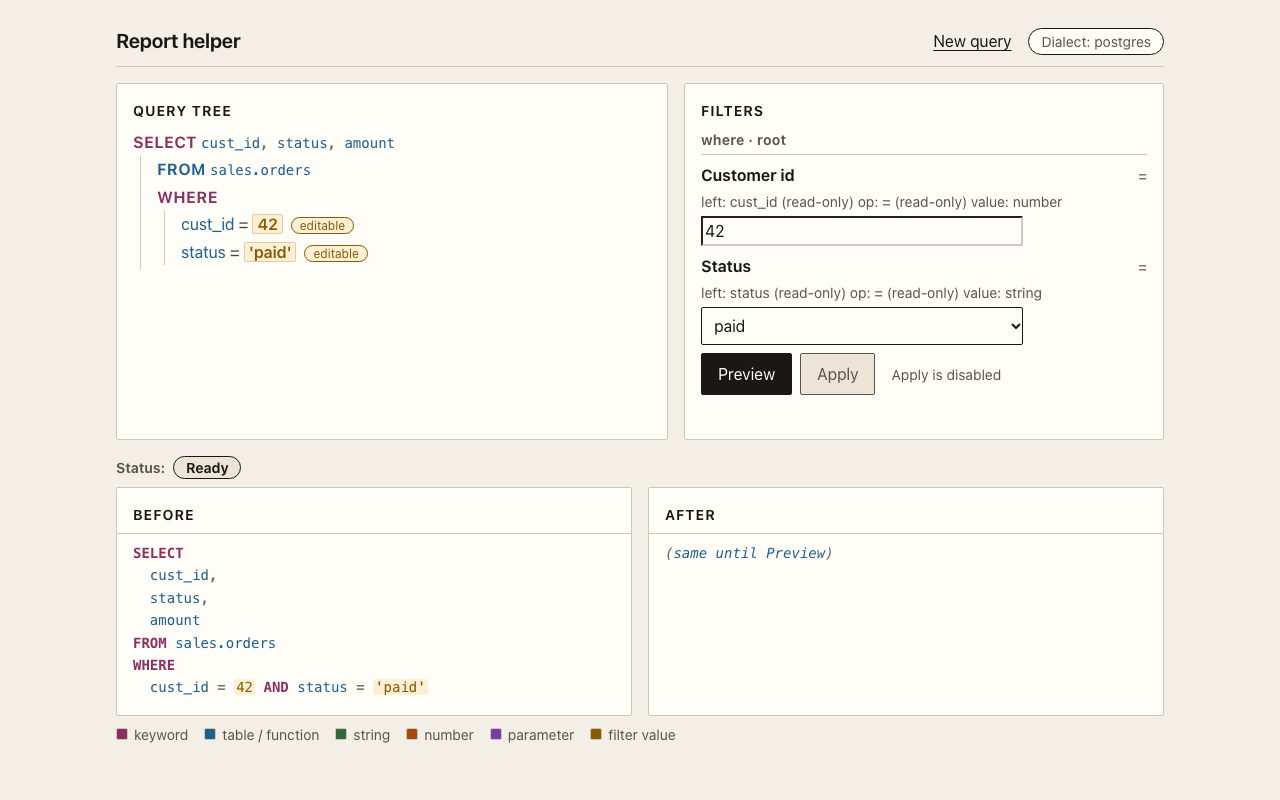
The report helper builds its filter panel from the product IR. Every editable node becomes a control: number, text, range, list, or limit.
pip install edgesql    # or: uv add edgesql
python -c "import edgesql, importlib.metadata as m; print(m.version('edgesql'))"
from edgesql import Query
query = Query.parse(
"SELECT cust_id, status FROM sales.orders",
dialect="postgres",
)
preview = query.preview(
lambda item: item.rename_column("cust_id", "customer_id", table="sales.orders")
)
if not preview.blocked:
applied = preview.apply(actor="builder")
print(applied.to_sql())
# SELECT customer_id AS cust_id, status FROM sales.ordersThe original query does not change. The rename keeps the output name
cust_id, so a report that reads that column still works.
The example app reads the product IR and builds one row per predicate. A literal value gets a typed control. A predicate that compares two columns, or compares against a function, becomes a read-only row, because a value patch would change the meaning.
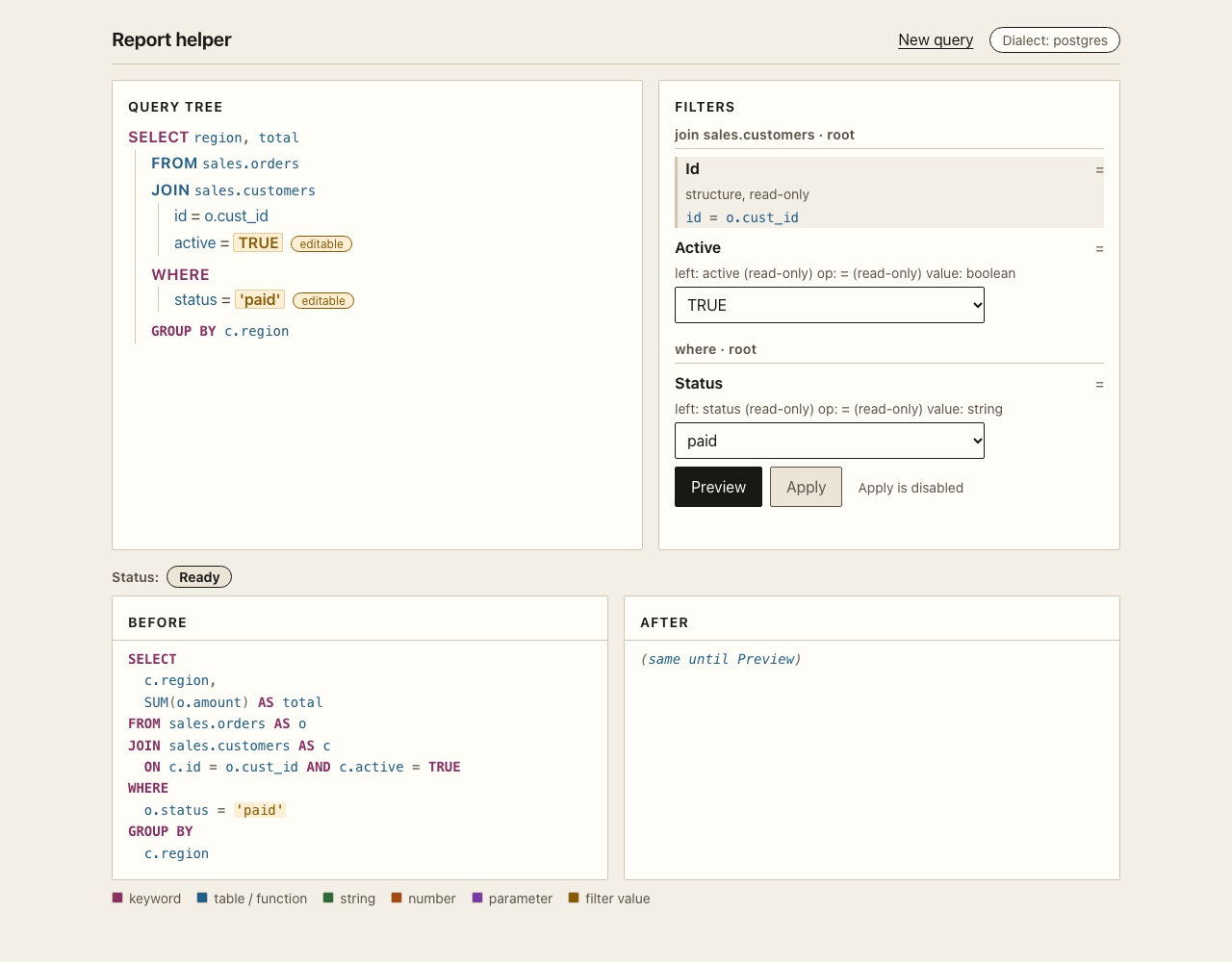
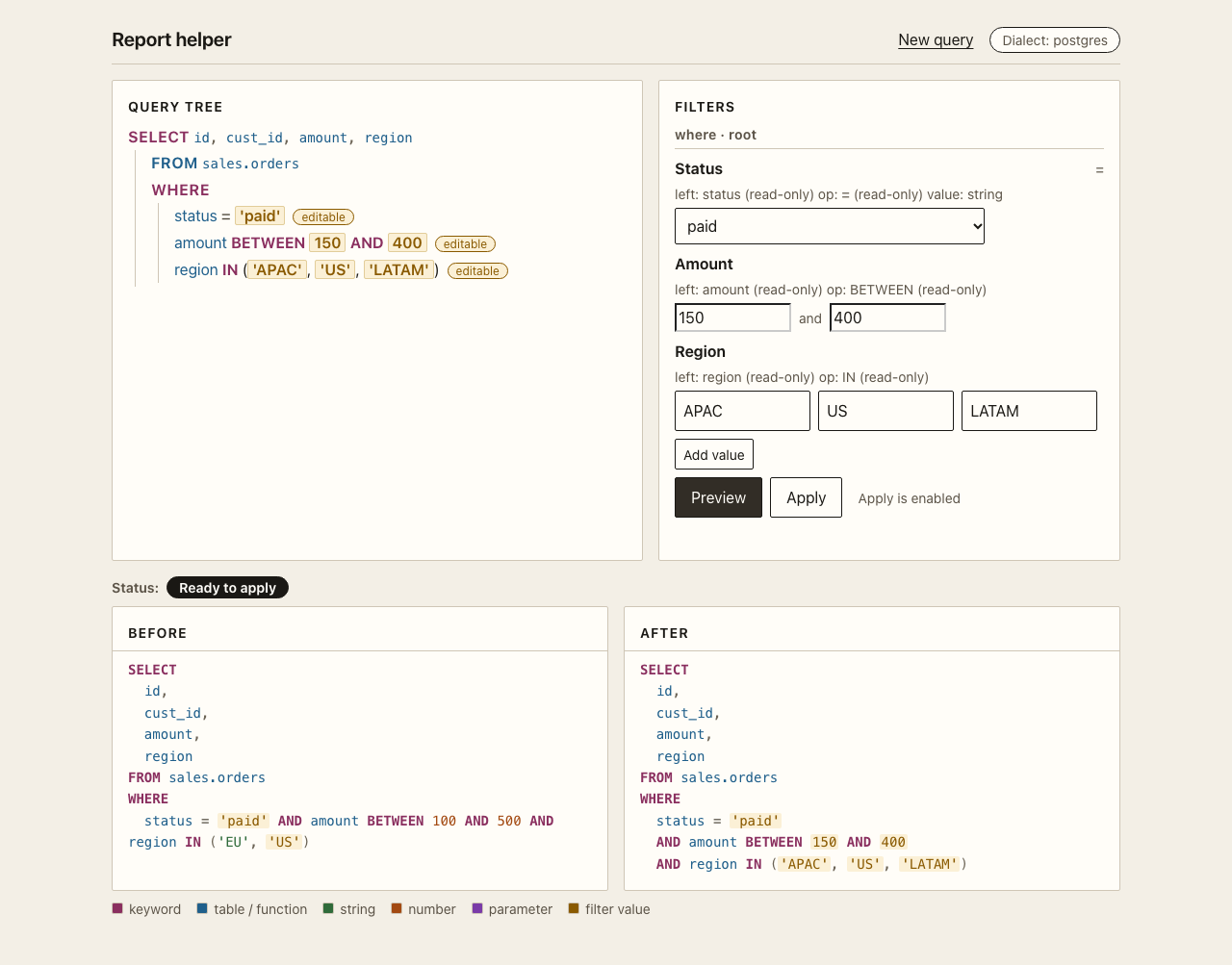
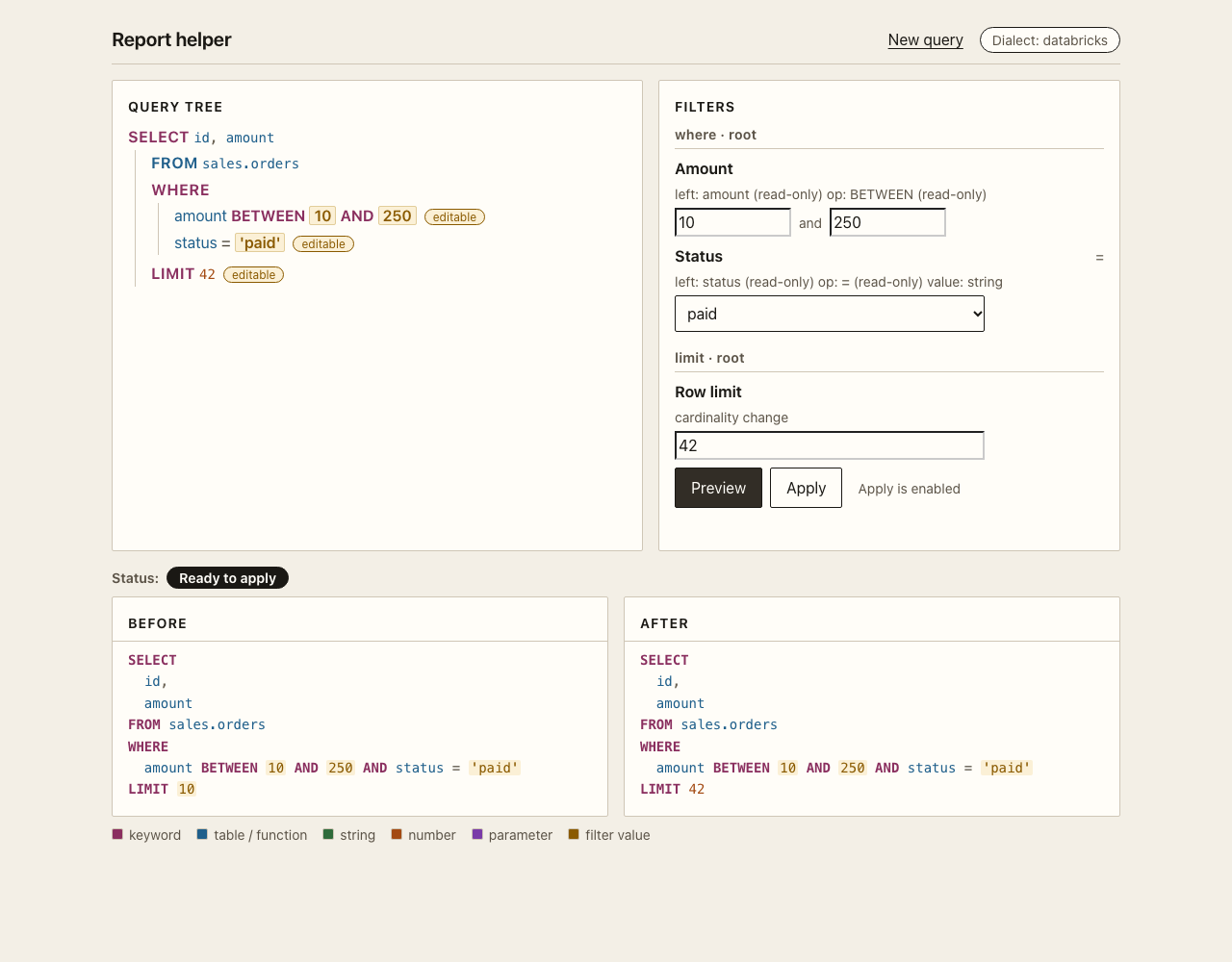
Six steps from install to a committed change, with the screen at each step.
Joins, subqueries, CTEs, recursive CTEs, QUALIFY, parameters, and limits, in both dialects.
The API, the error catalog, and the dialect matrix.
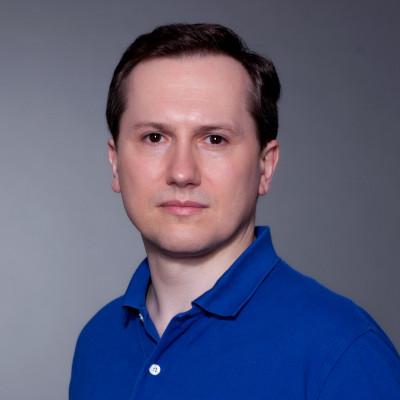
Raphael is a data engineering and AI strategist with more than 20 years of global technology leadership experience. He works on democratizing data management and AI, and helps organizations build scalable data platforms. His work covers resilient data infrastructure, machine learning models, and coaching teams on practice. He leads a startup studio in Hong Kong.
EdgeSQL started from one observation: changing SQL with string replacement breaks as soon as two edits touch the same name. A typed tree with a preview gate is the smallest honest fix, so he built it and tested it against the official Postgres and Databricks statements.
Favikon ranks Raphael at 12 in Top 20 AI Experts in France in 2026, with a Favikon Authority Score of 7,012 points. The list covers the most visible AI practitioners in France. The entry cites his 20 years of data and AI leadership, his work on scalable data platforms, and the startup studio he leads in Hong Kong.
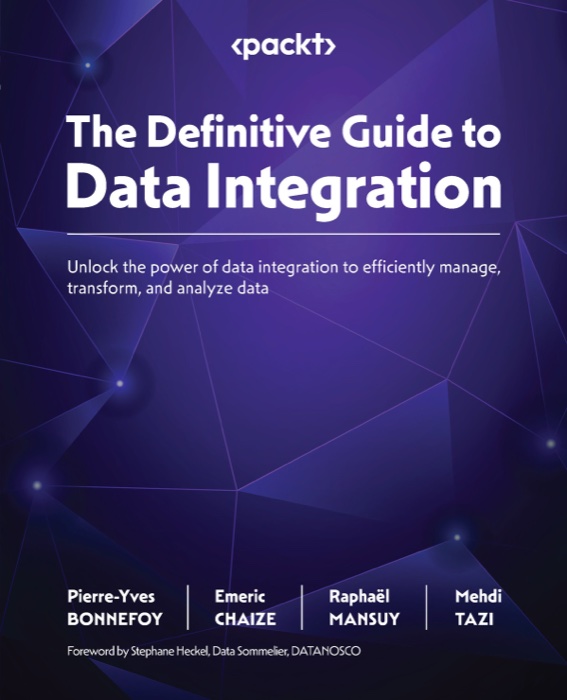
Unlock the power of data integration to efficiently manage, transform, and analyze data. Raphael is a co-author with Pierre-Yves Bonnefoy, Emeric Chaize, Mehdi Tazi, and Stephane Heckel.
Graph-RAG in Rust: one binary, one Postgres, any LLM. It reads PDFs and text, builds a knowledge graph in PostgreSQL, and answers questions with sources. Six retrieval modes: naive, local, global, hybrid, mix, and bypass. Apache 2.0.
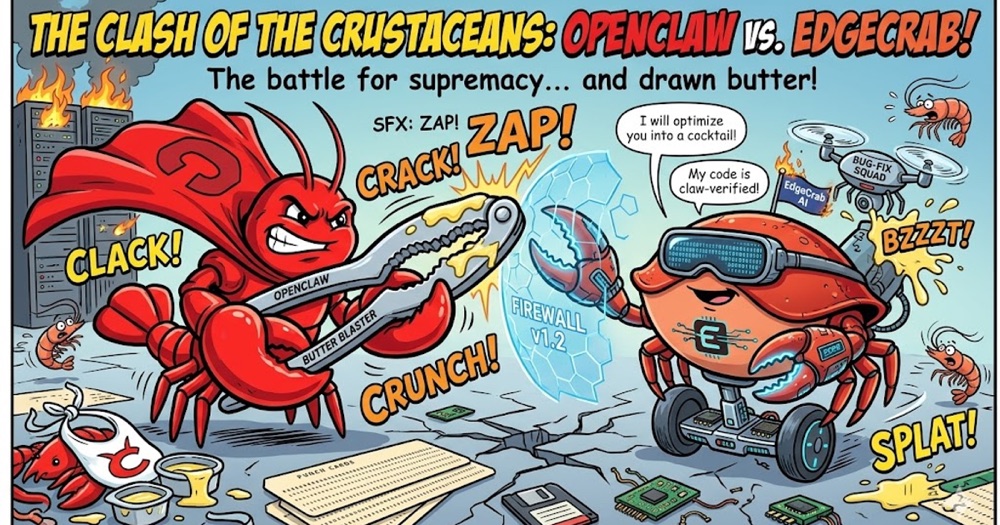
A personal and coding SuperAgent in one native Rust binary, with a
ratatui terminal UI and a ReAct tool loop. It supports 24 LLM providers and
17 messaging gateways. Install with npm install -g edgecrab-cli,
pip install edgecrab-cli, or cargo install edgecrab-cli.
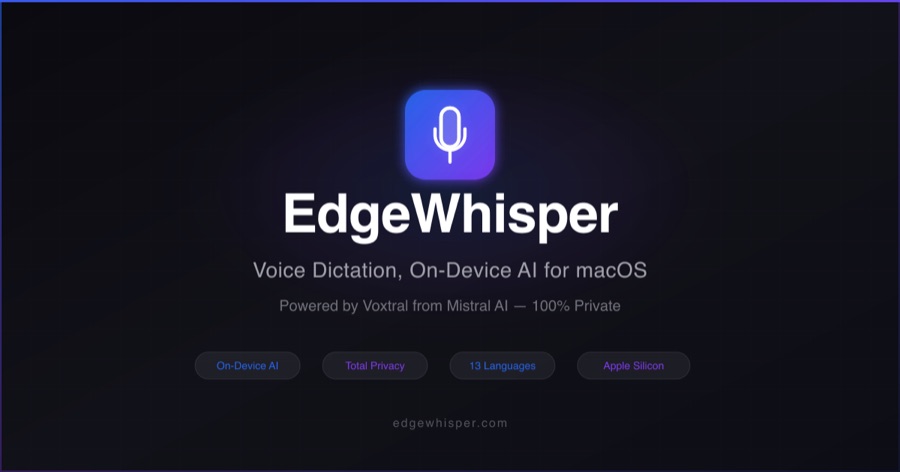
Voice dictation for macOS, powered by Voxtral from Mistral AI. It runs fully on the device, with no cloud and no data collection. It supports 13 languages, an Apple Silicon Mac, and macOS 14 or later.
Building something with SQL? Tell Raphael about it.
Connect on LinkedIn